
By Tyra Lawrence
Fears regarding the water saving strategies being implemented in residences were unfortunately justified as house committee member and second year student Abigail Petrie developed a kidney infection resulting in a hospital visit and ultimately the discontinuation of the “Wee Wiser” dial at Margaret Smith House.
Makhanda has been experiencing a crippling drought causing the citizens of the town to enforce strict water saving strategies which includes limiting the number of times that the toilets should be flushed. In order to help alleviate the effects of the drought and push day zero away enough to be able to use a comfortable amount of water once more. Upon implementing water saving strategies within residences and around campus, there were immediate concerns about hygiene issues which were addressed in a press conference which took place on the 14th of March by Ms Ilva Pietere who claimed that collected water was properly treated before it was used to flush the toilets. According to Abigail, the process of regulation has not been done well. “On my floor in my bathroom, we had two buckets with (grey) water in them and the thing is stagnant grey water grows bacteria… it’s actually festering, growing bacteria on top and we must use that to flush the toilets. It’s no wonder I got sick,” explained Abigail.
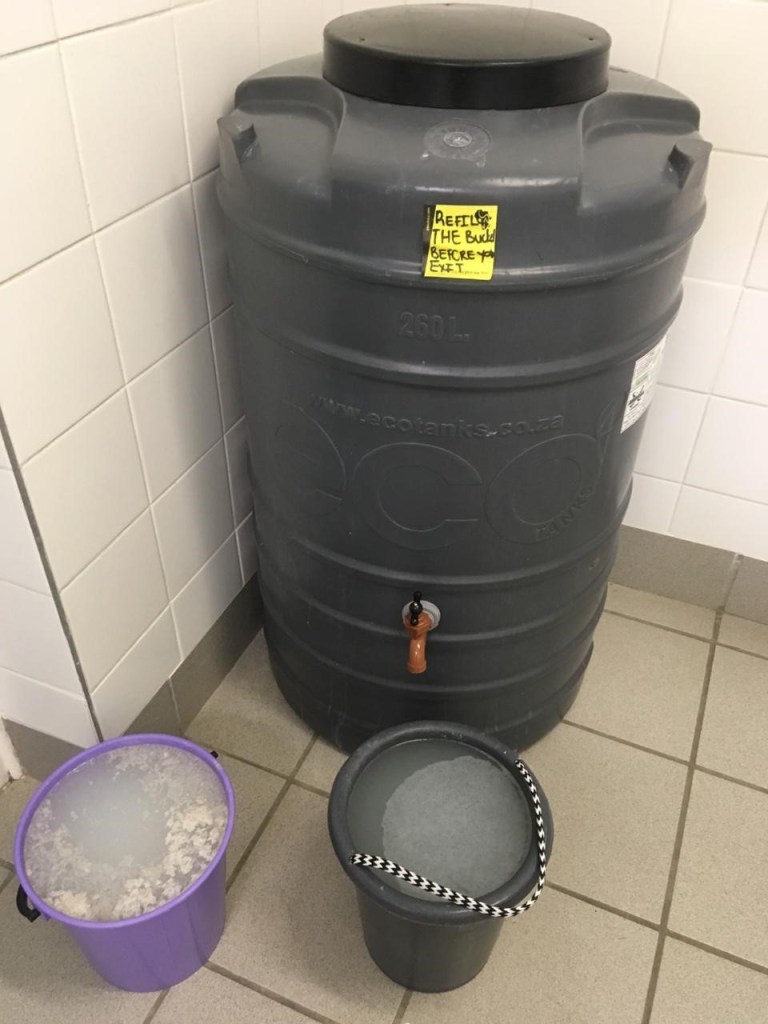
Almost every bathroom in the residences and around campus are cluttered with the “Wee Wiser” dial and snippets of information stating how much water is used in a single flush as well as numerous strategies regarding the appropriate amount of water to use. “Water saving strategies like not flushing the toilet until three people have urinated in it and collecting soapy shower water to be used to flush the toilets were a concern from early on,” said Jamie-Lee Antony, a first-year student and resident of Margaret Smith House, “now that the dial has been removed, I hope they do the same for the water basins.” Abigail claims that there was a water shortage last year, which was not as severe as the present, and that she would not have been so sick if the strategies were properly thought out. The infection that Abigail claims were caused from the water saving strategies landed her in hospital for two weeks which affected her academic work.
The unhygienic conditions and water saving strategies that were being implemented by Margaret Smith House forced Abigail to find different accommodation as she stated that paying to live in an apartment would cost a lot less than staying in the residence and being in and out of hospital due to infections. “One thing I kept saying after I got sick and I still say to this day is that I am not the first person to get sick from the water crisis in Grahamstown and I’m sure as hell not going to be the last… One of the reasons I left res was because of the hygiene… so I moved out for academics but also because of my health and hygiene.” Said Abigail.
It is unclear whether or not other residences around the university campus are having the same problem with the chlorination of collected water or toilet flushing procedures, however in Margaret Smith House, the “Wee Wiser” dial has been permanently discontinued and the toilet must now be flushed after every use to avoid anyone else becoming ill. The university runs a risk of being sued by a student who falls ill due the strategies that they have implemented therefore the decision on what should be done about the ones making students fall ill is solely up to them. Seemingly the next strategy that will be discontinued at Margaret Smith House is the water basin as very few residents actually use it as the bucket is heavy to carry when full not to mention the health risks associated with it as people may have infections that can be passed along through water that is left to sit in the tanks, buckets and toilet bowls.
While it is important for students and citizens of Makhanda alike to do their part to save water, the health and hygiene of the people must be considered before a water saving strategy before it is hastily implemented without considering how it will affect the people upon which it is forced upon. A concern brought up during the conference concerning the state of Makhanda regarding water was that students were not made aware of the water crises before they arrived and thus did not have enough time to prepare themselves. Some students even went as far as to say that if they had known about how bad the situation was they would have chosen a different institution in which to peruse their academics. Both the students and the university are in a difficult situation. Attempting to save water and simultaneously be hygienic and considerate of students’ health is a difficult task. Until there is a solution which satisfies both sides, there will continue to be uneasiness and concern about water and how it should be used.
 Diversity Times